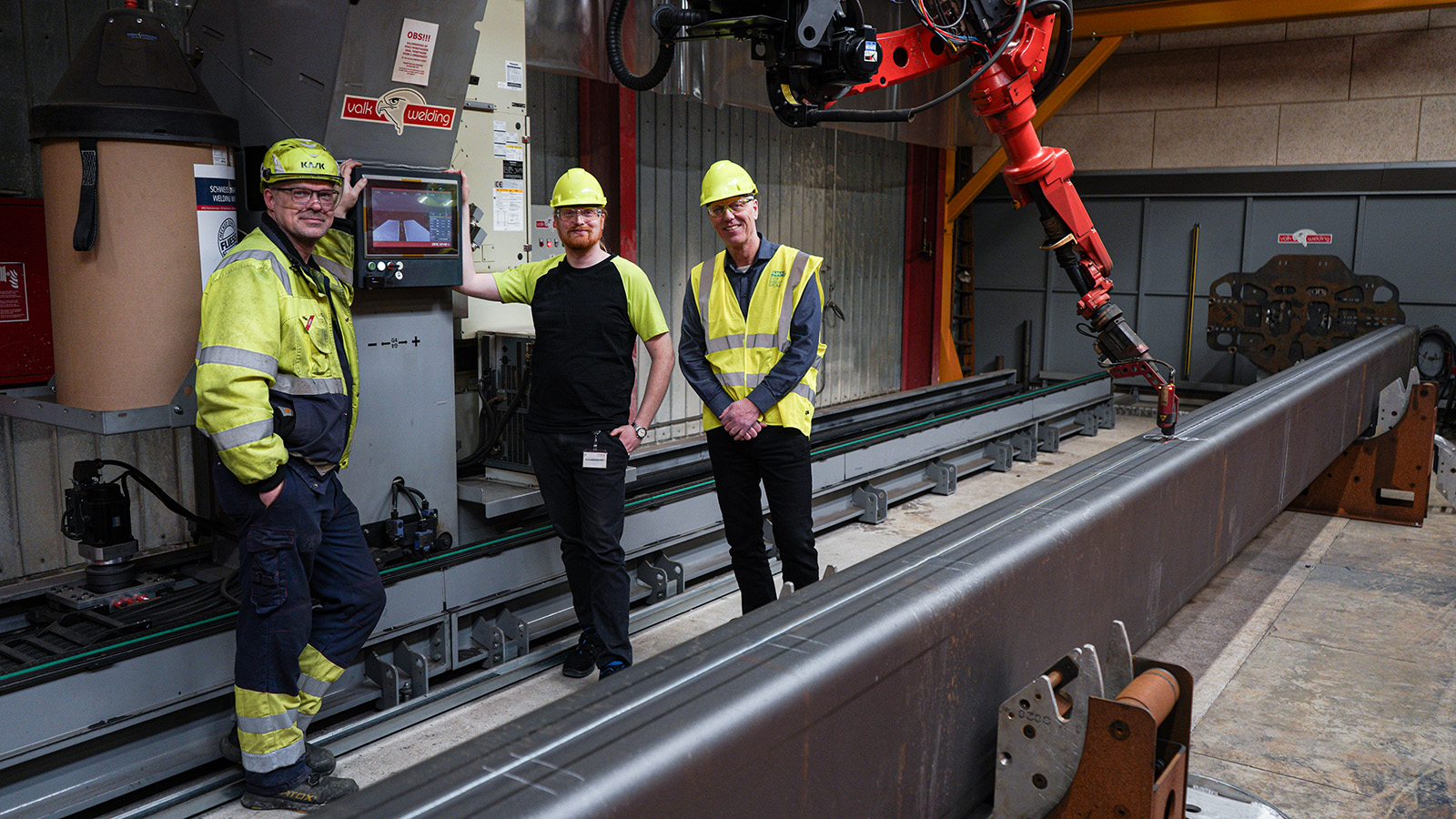
“That is precisely the assumption we have challenged at Ib Andresen Industri,” says Head of Sales, Lars S. From. “We automate small series – even down to single-piece production. Not as an exception, but as a standard.”
“For our customers, this means a faster transition from design to stable production, consistent quality from the very first unit, and significantly lower technical risk during ramp-up. Complex products can be moved into robotic production without lengthy commissioning phases, and time-to-market is substantially reduced – even when designs are adjusted along the way.”
Automation in our welding department is not reserved for mass production. At Ib Andresen Industri, it is not batch size that determines whether automation is applied – it is the value it creates.
Automation Without Volume Constraints
The core of our setup is not the robot itself. It is the interaction between:
-
Modular and custom-designed welding fixtures
-
Offline programming
-
Digital models of our robotic cells
-
Full welding simulation in the digital environment
-
Close integration between development and production
“When we receive a new design, both the fixture and the robot program are developed digitally before anything is built physically. We simulate the entire welding process in a digital model of our production setup to ensure everything works – without collisions and without surprises,” explains Morten Jensen, Operations Manager of the Welding Department.
This enables Ib Andresen Industri to launch new products into production without the traditional, lengthy commissioning phase. In one specific case, it took just 2.5 hours from mounting a new fixture to completing the first welded component. A traditional ramp-up for a comparable product can take up to 14 days.
“That is the difference between making minor offline adjustments in the robot program – and having to start over completely,” adds Morten Jensen.
“Press Play and Walk Away” – In Practice
Internally, we call it “Press Play and Walk Away.” It reflects a production logic where the program is developed offline, the weld is fully simulated in advance, and the robot is started in automatic mode from the very first part.
The first unit is run at reduced speed as a precaution. After that, production runs at full pace.
“The key point is that our customers avoid uncertainty, delays, and unforeseen costs,” says Morten Jensen.
Why This Is Not Standard Practice
Automating small series may sound straightforward in theory, but in practice it places significantly higher demands on the organization than traditional serial production.
It requires thoroughly engineered fixture design, deep welding expertise, advanced digital simulation capabilities, and disciplined project management with close collaboration between development and production.
“If just one of these disciplines lacks maturity, the automation becomes fragile. Commissioning drags on, flexibility disappears, and the benefits of robotics are diluted,” explains Morten Jensen.
Many companies are strong either in manual flexibility or in high-volume automation. Combining the two – delivering robotic stability in an environment characterized by small series and varying designs – is far more difficult.
This is precisely where Ib Andresen Industri has chosen to invest. Not only in equipment, but in processes, competencies, and cross-functional collaboration.
Photo: Tomas T. Frederiksen (left), Simon Askholm-Block og Morten Jensen.